Ten Thousand Dice Game Rules
Ten Thousand is a dice game for 2-8 players. A game typically takes 20-45 minutes, and the recommended age is 8+.
Rules for Ten Thousand: Roll six dice, set the scoring ones aside and stop before an empty roll takes the whole turn. Ten Thousand is also known as 5000, Dix Mille or Ten Grand.
Ten Thousand and Farkle are one game in two editions. This page uses six dice and a target of 10,000. Farkle has its own scoring table and answers to Zilch, Zonk and Greed.
Setup
Six dice, a sheet of paper and a pen is the whole kit. A dice cup keeps the rolling tidy, but nobody needs one. Two players is enough and eight still works, and the only skill the game asks for is adding up hundreds.
You are racing to 10,000 points. Scores go on the sheet turn by turn, and a full game usually runs half an hour or more. Pick a starter, say whoever rolls highest on one die, and pass the dice clockwise from there.
Scoring tables in this family differ from one household to the next. Settle the table and the opening requirement before the first roll, not once somebody already has 4000 written down.
How to play
Your turn begins with all six dice. Every roll has to leave you at least one scoring die or combination to set aside. Once you have, the choice is yours: write down the total you have collected this turn, or roll whatever dice are left and push it higher.
That is the loop, roll after roll, and each roll has to produce something new. Call your running total out loud. It keeps the table with you, and it makes the moment to stop easier to spot.
A roll with nothing in it ends the turn at zero. Everything collected during the turn is gone and the dice move on. What you have already written down is safe for good.
Setting one scoring die aside is the minimum, not the limit. If a roll shows both a 1 and a 5, you may keep the 1 and throw the 5 back in with the rest.
Scoring
Ones and fives are worth something on their own. Everything else has to arrive as three of a kind or better, as a run of six, or as three pairs.
| Combination | Points |
| Single 1 | 100 |
| Single 5 | 50 |
| Three 1s | 1000 |
| Any other three of a kind | the number times 100 |
| Four, five or six of a kind | double for every die above three |
| Run of 1 to 6 | 1500 |
| Three pairs | 1500 |
Three 4s make 400 and three 6s make 600. The doubling builds on the triple, so four 6s give 1200, five 6s 2400 and six 6s 4800. With ones the ladder runs 1000, 2000, 4000 and 8000, and six 1s is the most a single roll can be worth.
Combinations have to arrive in one roll. Set a 1 aside, then roll two more 1s next time, and you hold three single ones for 300 points instead of a triple for 1000.
A 2, a 3, a 4 or a 6 on its own is dead weight. Those faces only count inside a combination, which is why a throw of three dice so often comes to nothing.
When all six dice score
Get all six dice scoring and you pick the whole set back up and carry on in the same turn, total intact. Most players call this hot dice, and there is no cap on how often it can happen in one turn.
The six do not have to score in a single roll. Three 6s set aside early, then a 1, a 1 and a 5 on the last three dice, and the full set comes back to you.
The big turns nearly all start here. A fresh set of six scores in roughly 39 rolls out of 40, so most players take the reroll even with 1500 points sitting in front of them.
Getting on the board
Before you may write anything down at all, you have to collect 1000 points in a single turn. Stop at 850 and you get nothing, still on zero as the dice move on. So you keep rolling until you clear 1000 or until the turn falls apart.
It is a one-time toll. Once you are on the board you may bank as little as you like, and a 150-point turn makes perfect sense when you are in front.
Tables vary. 1000 is the usual figure in Ten Thousand, 350 and 500 both turn up, and some groups drop the requirement entirely. A low threshold has everyone playing within a couple of rounds. With 1000, half the table can still be on zero while the lucky one closes in on 4000.
A turn from start to finish
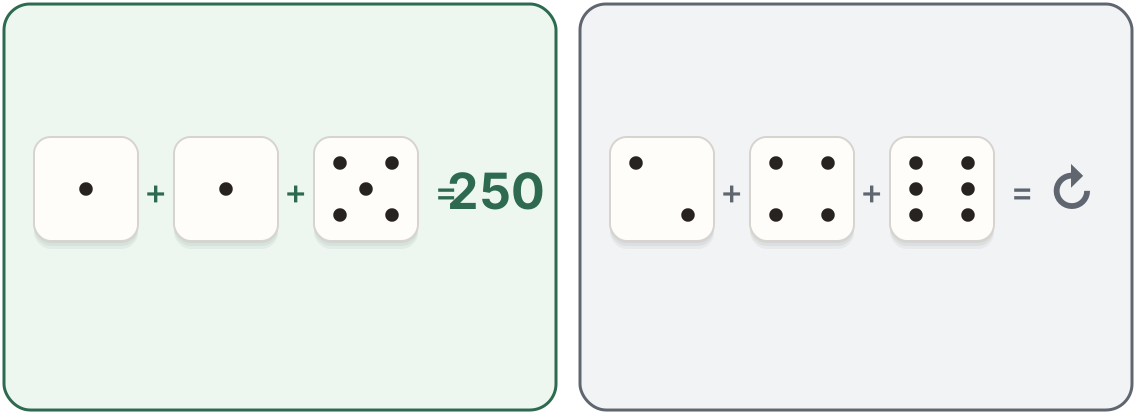
You roll all six and get 1, 1, 2, 4, 5, 6. The pair of ones is worth 200 and the five another 50, so you set those three aside for 250 and throw the 2, the 4 and the 6 again.
They come up 6, 6, 6. That is 600 more and a turn total of 850. All six dice are set aside and scoring now, so you can write down 850 or roll the whole set again.
You roll on and get 2, 3, 3, 4, 6, 6. No ones, no fives, no triple. The turn ends at zero. One roll earlier those 850 points were yours.
Winning
Whoever first reaches 10,000 or more sets off the last round, and every other player gets one more turn to finish above them. When the round is done, the highest total wins.
That final turn is a different game. Sitting 1400 behind, a safe 600 does nothing for you, so you keep rolling until you have enough or until the turn dies.
About this version
These rules cover Ten Thousand with six dice and the most widely played scoring table: single ones and fives, three of a kind and up with doubling for every extra die, a run of 1 to 6, and three pairs. Getting on the board takes 1000 points in one turn, and the first player to 10,000 sets off a final round. Point values differ a great deal across this family, and the common departures are listed under Variants.
Do you play with different rules where you live, or did you spot a mistake? Send me an email.
Similar games
Farkle (alias Zilch, Greed, Zonk, Hot Dice or Squelch)
Roll six dice, set scoring dice aside and stop before a farkle wipes out your turn.
Qwixx
Everyone joins in on every roll. Cross off numbers from left to right in four coloured rows, and lock a colour before the others do.
Jackpot
Roll two dice around a ring of numbered spaces, and empty the jackpot when the sum comes up seven.