Qwixx Dice Game Rules
Qwixx is a dice game for 2-5 players. A game typically takes 15-20 minutes, and the recommended age is 8+.
Rules for Qwixx: Everyone joins in on every roll. Cross off numbers from left to right in four coloured rows, and lock a colour before the others do.
Setup
You need six dice for Qwixx, plus a score sheet and a pen for each player. Two of the dice are white, the other four are red, yellow, green and blue. Two to five people can play, and it works from about age eight, since every turn involves adding two dice together.
The score sheet holds four coloured rows numbered 2 to 12. Red and yellow count upwards, 2 to 12. Green and blue run the other way, 12 down to 2. Every row ends in a lock box on the right. Below them sit four penalty boxes and a small table showing what your crosses are worth.
You want as many crosses as you can get in those four rows, with as few penalties as possible. Take turns rolling a single die, and whoever gets a 6 first becomes the active player.
Left to right, always
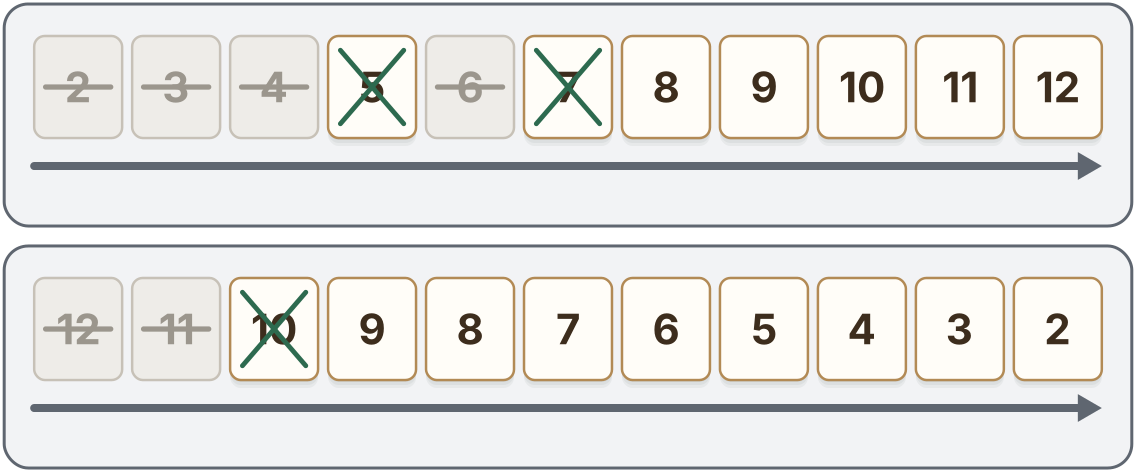
Qwixx runs on a single rule: within a row, numbers are crossed off from left to right. Starting at the far left is not required, but whatever you skip is gone for good.
Suppose you cross off red 5, and a few rolls later red 7. Red 2, 3, 4 and 6 are closed to you from then on, and only 8 and up remain in that row. Jump straight to red 10 early in the game and you have shut eight boxes with one stroke.
Worth doing: draw a thin line through the numbers you skip. One glance then tells you what is still open, and nobody crosses off a number that was already dead.
How to play
The active player rolls all six dice in the middle of the table. Two things follow, and the order never changes.
The white dice come first. The active player adds them up and calls the sum out loud. Every player may now cross off that sum in one of their four coloured rows, including the players whose turn it is not. Each of them picks the row, and nobody has to cross anything off.
Then comes the coloured part. Only the active player may combine one white die with one coloured die and cross off the total in the row matching that coloured die. Optional again.
So the active player can end up with two crosses, while everyone else gets at most one. The order matters only when the active player wants both, because the white cross has to be made first. Once everyone is done, the player on the left takes over and rolls all six dice again.
A turn, step by step
Kari is the active player. Her roll: white 4 and white 1, red 3, yellow 6, green 5, blue 6.
She adds the white dice and calls five. She crosses off yellow 5. Ola crosses off red 5 on his sheet. Mia has red 6 already, and none of her other rows can take a five without wasting boxes, so she skips it. That costs her nothing at all.
Now the coloured half, which belongs to Kari alone. She pairs the white 4 with the blue 6 for a total of 10 and crosses off 10 in blue. Blue counts down from 12, so blue 12 and 11 are lost to her from here on. In exchange she got two crosses in one turn.
Ola takes over as the active player.
Locking a colour
At the right-hand end of each row sits 12 in red and yellow, 2 in green and blue. Before you may cross that number off, five other numbers in the row must already be crossed off.
Cross off the last number and you mark the lock box beside it at the same time. That colour is now shut for everyone at the table, and no further numbers can be crossed off in it. The coloured die leaves the game straight away, so its combination cannot come up again.
The lock counts as a cross when the scores are added up. A locked row is therefore worth at least seven crosses: the five you had, the last number, and the lock itself.
When a lock happens on the white sum, several players can lock the same colour at once, provided each of them also has five crosses in that row. A third row can even close at the same moment as the second. Either way the game is over.
Penalties
An active player who ends the turn without a single cross, neither on the white sum nor on a coloured combination, has to mark one penalty box. Each one costs 5 points at the end.
That holds even when a cross was available and the player turned it down. Protecting your rows is allowed, and the penalty is the price of it.
Nobody else pays. A player who is not active can let the white sum go by for free, so only the player holding the dice can lose points by sitting out.
Penalties also run the clock. When someone marks a fourth penalty box the game stops immediately, and that player carries 20 minus points into the count.
Scoring
Each colour scores from the number of crosses in the row, lock included. The table at the bottom of the sheet gives the values, and every extra cross is worth more than the one before it.
| Crosses | Points |
| 1 | 1 |
| 2 | 3 |
| 3 | 6 |
| 4 | 10 |
| 5 | 15 |
| 6 | 21 |
| 7 | 28 |
| 8 | 36 |
| 9 | 45 |
| 10 | 55 |
| 11 | 66 |
| 12 | 78 |
Add the four row scores together and take off 5 points for every penalty box you marked.
An example: Kari has 4 crosses in red for 10 points, 3 in yellow for 6, 8 in green for 36 and 7 in blue for 28. That comes to 80. Two penalty boxes cost her 10, so she finishes on 70.
End of the game
Two things can end the game: a fourth penalty box marked by any player, or a second colour locked. It stops right there, mid turn if need be, and no one rolls again.
Everyone totals up, and the highest score wins. Two players on the same total share the win.
Because the ending arrives without warning, keep an eye on the other sheets. A row one cross away from its lock can finish the game on the next roll.
About this version
These rules cover the base game: six dice, two white and four coloured, the standard sheet with four rows from 2 to 12, four penalty boxes, and the scoring table that starts 1, 3, 6. The first player to roll a 6 becomes the active player. The extra pads and the other editions in the series are described under Variants.
Do you play with different rules where you live, or did you spot a mistake? Send me an email.
Similar games
Ship, Captain and Crew (alias 6-5-4)
Secure the 6, 5 and 4 in strict order within three rolls, and let the last two dice be your cargo.
Mafia Dice
Pass sixes on, drop ones in the middle and be the first player to get rid of every die you hold.
Aces to the Centre (alias Aces)
Aces leave the game, twos go left and fives go right, until the very last die decides it all.