Pig Dice Game Rules
Pig is a dice game for 2-10 players. A game typically takes 10-20 minutes, and the recommended age is 5+.
Rules for Pig: Roll the die as many times as you dare, but a 1 wipes out the whole turn. First to 100 points wins.
This page covers the dice game Pig, not the card game with the same name. The card game is at Nordic Card Games.
Setup
One die, a sheet of paper and a pencil are all you need. Pig works with 2 to 10 players, and the first player to 100 points wins.
Rule the paper into a column per player. Each turn you keep goes into your column, with the running total underneath, so everybody can see who is closing in on 100.
Settle the starting player with one roll each and carry on clockwise. Most turns are over in a couple of rolls, so nobody sits around waiting.
Dice made for the game do exist, with a skull where the 1 should be. They are sold as death dice and change nothing about the rules.
How a turn works
Roll the die and add the pips to your turn total. After every roll you decide for yourself: go again, or stop.
Stop, and the turn total goes into your column and on to your score. The die then passes to the player on your left.
Roll a 1 and the turn is finished on the spot, with the turn total gone.
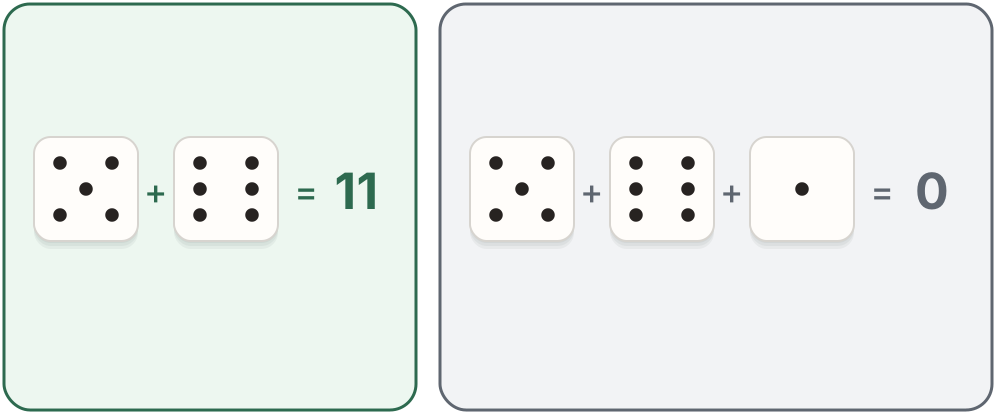
Say you open with a 5 and roll again for a 6. The turn total is 11, and you can bank those 11 points or push for more.
A 1 wipes out the turn total
In Pig the danger is the 1, and it costs you everything the turn has gathered so far. Sitting on 11 and rolling a 1 leaves nothing to write down.
Points banked in earlier turns are safe forever. Whatever happens later, the total in your column stands.
One roll in six is a 1, whatever the die did the roll before. Five rolls in a row without one comes off 40 times in 100.
When another roll is worth it
A roll puts the turn total at risk and pays 4 pips on average when it works, since 2, 3, 4, 5 and 6 average out at 4.
Five rolls in six work, so the gain is five sixths of 4, which comes to 3.33 points. What you put at risk is a sixth of whatever the turn has built up.
On a turn total of 12 you are risking 2 points against a gain of 3.33, so rolling is the better move. On 20 the two figures match at 3.33 apiece. Above 20 a roll costs more than it brings in.
That is where the familiar advice to stop at 20 comes from.
Winning
Reaching 100 points or more wins the game there and then. Bank 14 from a score of 88 and the game is finished.
Some tables play the round out instead, so that everyone has had the same number of turns, and let the highest total win. That gives a player who is behind one last chance to catch you. Agree which of the two you are playing before the first roll.
Playing the round out can leave two players level, and they settle it with an extra turn each.
Stopping at 20 leaves about six turns in ten worth nothing, while the ones that survive bring a little over 20 points. That averages out at just above 8 points a turn, so expect a dozen turns each before somebody passes 100.
Playing with children
The rules take a minute to learn, and children from about five manage well with an adult keeping score. Holding a turn total in your head and adding to it is arithmetic practice that feels like nothing of the sort.
Set the target at 50 for the youngest players. A game then takes five minutes, and they will usually want a second one.
Maths teachers use Pig for probability lessons too. One in six is easy enough to grasp, and the choice between rolling and stopping puts a number on something a child can feel.
About this version
These rules cover single-die Pig, where a 1 costs you the turn total and the first player past 100 wins immediately. The version that plays the round out, giving everyone the same number of turns, is included, along with two-dice Pig, Big Pig, Hog and Skunk. The averages and probabilities were calculated for a player who stops at 20 points.
Do you play with different rules where you live, or did you spot a mistake? Send me an email.
Similar games
Sevens Out
Roll two dice and keep scoring until a seven ends your turn. The first player to 500 points wins.
Fifty
Only doubles score, double 6 is worth 25 and double 3 wipes your score. The first player to reach 50 points wins.
Drop Dead
Roll five dice where twos and fives go dead, and score the most points before every die is gone.