Midnight Dice Game Rules
Midnight is a dice game for 2-8 players. A game typically takes 10-20 minutes, and the recommended age is 6+.
Rules for Midnight: Roll six dice, keep as many as you like each roll, and secure a 1 and a 4 before the other four dice count towards your score. Midnight is also known as 1-4-24.
Setup
Midnight takes six dice and a table. Bring chips or matchsticks if the round is played for a pot, or a pen and paper if you would rather add up points.
Anywhere from 2 to 8 players works. Only one person rolls at a time and a turn is over in half a minute, so nobody waits long.
What you are after is a 1 and a 4 among your six dice by the end of the turn, with the other four as high as you can get them. Miss either of those two and you score nothing at all. Highest roll on a single die starts, and play goes clockwise from there.
How a turn works
Your turn opens with all six dice.
Look at what came up and decide which dice to keep. At least one has to stay, but whether that is one die, three or the whole roll is your call. Everything else goes back in for another throw, and again you choose what stays. Carry on until all six dice sit in front of you, and the turn is done.
Kept dice are out of play for the rest of the turn. The 2 you regret is still there at the end, and a 6 counts the same whether it arrived on the first throw or the last.
Keep a single die at a time and the turn gives you six rolls. Grab three at once and three rolls are all that is left.
A 1 and a 4 must be among your six
Your six dice have to include a 1 and a 4 for the turn to score. They can arrive in any order and at any point in the turn. End up with only one of the two and the whole turn is worth nothing, even when everything else shows a 6.
Neither the 1 nor the 4 adds to your score. The other four dice are the ones that count.
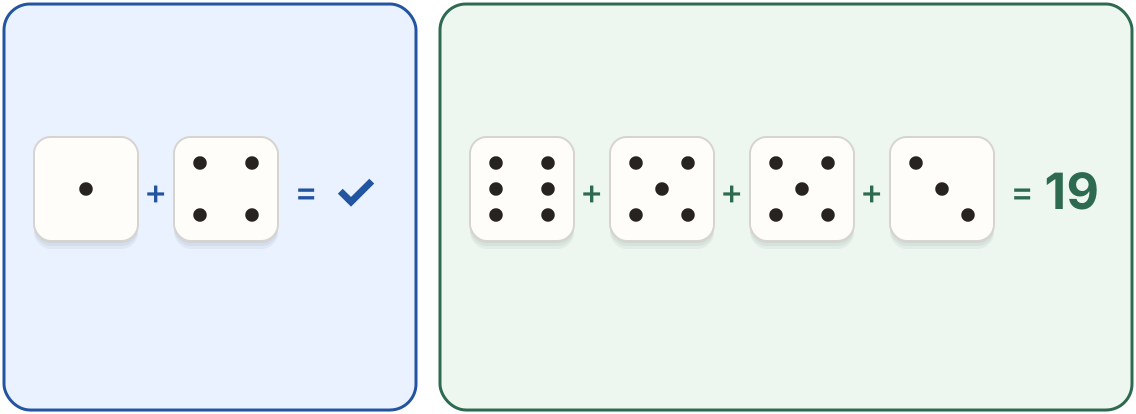
Roll several of them and only one 1 and one 4 go towards the requirement. The rest count as ordinary dice. End on 1, 1, 4, 4, 5 and 5 and you drop one 1 and one 4, which leaves 1 + 4 + 5 + 5 = 15 points.
Scoring
With all six dice in front of you, take away a 1 and a 4 and add the pips on the remaining four. That total is your score for the round.
A finish of 1, 4, 6, 5, 5 and 3 works out at 6 + 5 + 5 + 3 = 19 points. The best you can do is 1, 4, 6, 6, 6, 6 for 24, and that is where the game gets its other name, 1-4-24.
A turn that qualifies averages around 18 points, so 19 is a solid round, while a 24 shows up in a couple of turns in a hundred.
Deciding how many dice to keep
Every die you keep is one fewer die to search with. Stick to one at a time and you get 21 individual throws out of the turn (6 + 5 + 4 + 3 + 2 + 1). Keep three on the opening roll and you are down to twelve.
For a single die the sums are quick. Thrown again it comes back showing 3.5 on average, so a 5 or a 6 is worth keeping, while a 2 or a 3 is usually worth another throw as long as rolls remain.
Keeping everything that is left and finishing early is allowed too. With the 1 and the 4 secured and the last four dice showing 6, 6, 5 and 2, you can take the lot and stop on 19. Keeping 6, 6 and 5 and throwing the 2 again is the marginally better line.
One roll, two ways to play it
The opening roll comes up 2, 3, 4, 5, 6 and 6.
Played carefully, only the 4 stays and five dice go back in. They show 1, 2, 3, 5 and 6, so the 1 is secured and the turn is safe. The next four give 6, 6, 3 and 2, both 6s stay, and the final two dice show 5 and 4. Everything is kept and the score is 6 + 6 + 5 + 4 = 21.
Played greedily, the 4 and both 6s go down straight away. Three dice give 2, 3 and 5, and the 5 stays while the 1 is still missing. The next two show 3 and 6, and the 6 is too good to throw back. That leaves the whole turn resting on one die that has to come up 1. It comes up 3, and the turn is worth nothing.
A single die finds the number it needs one time in six. Had the 1 arrived, the greedy line would have paid 6 + 6 + 6 + 5 = 23.
Winning the round
Once everyone has rolled, the highest total wins the round. If nobody managed both a 1 and a 4, the round counts for no one and you play another.
When two players finish level at the top, they can settle it with one extra turn each, or the whole table can play the round over. Agree on which before you start.
How long you keep going is up to you. Some play round by round for a pot, others write the scores down and play to 100. Four players usually need about a quarter of an hour to get there.
Playing for a pot
Midnight has spent most of its life in bars and pubs. Losing and buying the next round is as good a stake as any, and at home a pile of chips or a bowl of matchsticks works just as well. Children at the table means chips, never coins.
Everyone antes the same amount before the round starts. Each player then takes a turn, and the best total wins the pot.
If nobody qualifies, or two players finish level, the pot rolls over. Nobody takes it out, everybody pays in again, and the next round is played for twice as much.
About this version
These rules describe the standard six dice version: keep as many dice as you like on each roll as long as one stays, and a 1 and a 4 are needed before the other four are added up. Both the pot and the race to 100 points are covered, along with the 2-4-24 variant. The probabilities in the strategy section come from a simulation.
Do you play with different rules where you live, or did you spot a mistake? Send me an email.
Similar games
Poker Dice (alias Indian Dice)
Roll five dice up to three times and build the best poker hand at the table, no cards required.
Chicago (alias Rotation)
Eleven rounds with two dice, where the goal is to hit the sums 2 through 12 in order, one per round.
Buck Dice
Roll three dice and count hits on the point number. Land on exactly 15 points to step out, and the last player left loses.